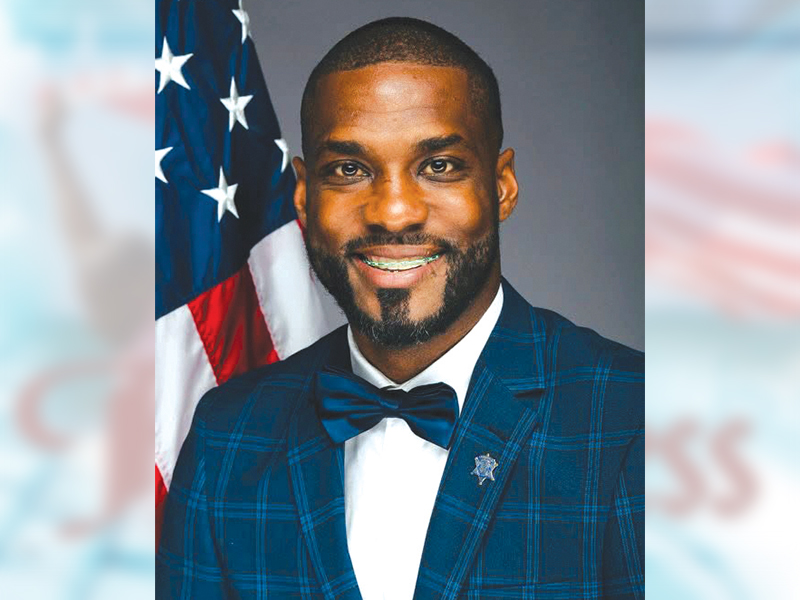
Addressing local voters directly, Monroe City Marshal candidate Chris Lewis posted a video on social media that set out to answer two persistent questions surrounding his campaign: whether he meets the legal requirements for the office, and whether he possesses the necessary law enforcement experience to serve, sidestepping his criminal background.
“A lot of people have inboxed me and saw me in public and want to know the answer to these two questions — qualifications and my experience,” Lewis said in a statement. “We’re going to dive right into it.”
However, behind the candidate’s pitch lies a complex trail marked by a prior criminal record, unresolved certification questions, and scrutiny over professional credentials, which Lewis has sidestepped.
A History of Convictions and Unverified Claims
Court records show Lewis was arrested for illegal use of a weapon in May 2007 and arrested one month later for possession of cocaine with intent to distribute as well as for attempt and conspiracy.
In April 2008, Lewis pled guilty to possession of cocaine and was sentenced to five years in prison at hard labor by Fourth Judicial District Court Judge Sharon Marchman.
Marchman suspended Lewis’ sentence and placed him on five years of supervised probation instead.
In July 2010, after admitting to a violation of his supervised probation, Marchman revoked his probation and sentenced him to three years in prison at hard labor. However, official public records contain no documentation showing he actually served the three years.
When asked where he served the three-year sentence, Lewis says that represents a dark part of his life that he would rather leave in the past and focus on winning the November 3rd election.
One law enforcement leader told the Free Press that Lewis became a confidential informant and “informed on his competition.”
Mashaw has publicly endorsed Marshal Robert Cherry, who Lewis seeks to unseat.
Despite these hurdles, Lewis has found backing among prominent local figures. Republican community leaders, including Monroe Mayor Friday Ellis and former Chamber of Commerce President Roy Heatherly, have actively worked to secure a gubernatorial pardon for Lewis. To date, no public record indicates the governor has signed a pardon, but his criminal record has since been expunged from public view. Despite the expungement, it remains accessible to law enforcement agencies under Louisiana law.
In his official campaign announcement, Lewis stated he is a licensed private investigator. However, state records show no history of him obtaining a Louisiana private investigator license. Neighboring states offer no indication of credentials either: Texas and Arkansas statutorily prohibit individuals with felony convictions from obtaining private investigator licenses, and Mississippi does not issue state-level private investigator licenses.
When asked which state he obtained his private investigator license in, Lewis would not say.
Lewis Rebranded
After completing his criminal sentences at age 24, Lewis has rebranded himself for the last 13 years. He entered local commerce, purchasing the West Monroe Coney Island, a trucking firm, and most recently a boys’ home in West Monroe. He also sat on a special advisory committee convened to assist in selecting the West Monroe Police Chief. He is also on the board of directors of several organizations in the city.
He is often seen making $1,000 donations to various civic groups, providing social outings for senior citizens, and giving away watermelons to senior citizens.
He is a deacon-in-training at the Calvary Baptist Church in West Monroe.
In 2023, he married Amanda Harris Lewis and is stepfather to her two sons.
The Legal Framework and the POST Challenge
Lewis maintains that he fulfills all legal requirements to appear on the ballot under state law.
“Louisiana law sets a clear bar for anyone seeking the office of marshal: candidates must be at least 18 years old, hold a GED or high school diploma, and have lived in the district without interruption for the past five years,” Lewis said. “I meet all those qualifications.”
Addressing his background directly, Lewis acknowledged his lack of standard law enforcement credentials.
“It is true, I have very little law enforcement experience,” Lewis admitted. “But where I lack in experience, I make up in integrity. I don’t have the amount of law enforcement experience that my opponent had, because — respectfully — I’m not 71 years of age.”
Mashaw says Lewis is correct: he meets the qualification to “run” for marshal, but after winning, the law will require him to be post certified to be a fully certified marshal.
Marshal is mostly an administrative job
Lewis pointed to the structure of the office itself, arguing that law enforcement experience is secondary to administrative skill in managing one of the state’s highest-paid local seats—a position that pays between $250,000 and $270,000 annually.
“In my opinion, it’s the reason why the state does not require the sheriff and the marshal to be POST certified, because 90% of that role is a leadership and administrative role,” Lewis said. “It’s leading an office, managing personnel, and balancing budgets.
He invoked several past officeholders to make his point, saying, “You’ve never seen Marshal Highshaw, Jay Russell, Richard Fewell, or Marc Mashaw, while serving in that capacity, out chasing bad guys. Their job is to lead an office, balance the budgets, manage personnel, and things of that nature — something I’ve done for nearly twenty years now.”
Twenty years ago, Lewis was 17 and was arrested for being a drug dealer.
However, Ouachita Parish Sheriff Marc Mashaw offered a starkly different legal reality regarding POST (Peace Officer Standards and Training) certification. Sheriff Mashaw stated that, because of Lewis’s felony criminal background, Lewis would be ineligible for POST certification through any law enforcement certification agency if elected without a pardon from the Governor.
Under Louisiana law, uncertified marshals lose active law enforcement authority, leaving them unable to execute arrest warrants, carry firearms on duty, or conduct field operations.
A Calling to Serve
Despite the legal and political obstacles, Lewis framed his candidacy as the natural evolution of two decades of local community work.
“I’ve watched the marshal’s office for nearly twenty years, and I believe it’s time for new energy and fresh ideas,” Lewis said. “Since I was a child, I’ve always wanted to serve in the military or serve my community in a law enforcement capacity. Life took me in a different direction, but the good part about it — it never changed my heart.”
In his statement, Lewis asked voters to weigh his personal trajectory and community investments when casting their ballots.
“I know a lot of promises are made during political season, but I ask that you take a look at what I’ve already done and let the work I’ve done speak for me,” he said. “Whether I win or whether I lose, I’m going to continue to serve the people, because this is truly my calling.”