
For Roslyn T. Downs, the month of April represents a profound intersection of life-changing news, the miracle of birth, and the enduring power of a “village” that refuses to let her walk alone. As the nation observes National Organ Donor Month, Downs is sharing her decade-long journey of survival, anchored by a life-saving gift from her brother and a faith that remains unshaken despite recent health setbacks.
The journey began on April 1, 2016, when Downs received the harrowing news that she required a liver transplant within a year. Despite the urgency, she faced a common medical hurdle: she did not yet meet the strict criteria for the national waitlist, which could have meant a five-to-six-year delay—time she simply did not have.
The solution came from within her own family. In November 2016, Downs’ brother stepped forward as a living donor, providing 60% of his liver to save her life.
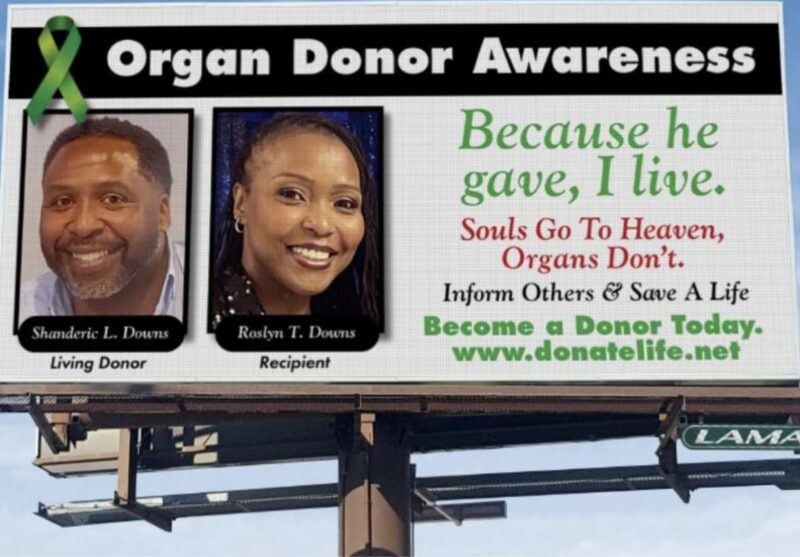
Roslyn and her brother Shanderic Downs are on billboards across the area promoting donor awareness
“Having a living donor was the recommendation and the best option to save my life,” Downs says. “April is a very special month to me, from it being the month of receiving life-changing news to also being the month of my son’s birth.”
A Journey of Resilience
While the transplant was a success, the road to recovery has recently seen new challenges. Since February 2025, Downs has been hospitalized more than 10 times and has undergone nine procedures.
On April 3, Downs expected to reach a significant milestone: the removal of a medical tube she has carried since August. However, lab results revealed that the procedure could not yet take place. The news was a heavy blow, leaving both Downs and her medical team in tears.
“I immediately felt depleted and defeated,” Downs admits. “I was making plans to simply enjoy the things we often take for granted—swimming, sitting in a bathtub, or getting dressed without thinking about disguising the tube.”
Yet, in the midst of her disappointment, Downs says she found a renewed sense of peace. She credits the “village” of support around her—from the hospital staff who held her hand to her parents, brothers, and son—for helping her shift her mindset from “prayer to praise.”
“My Condition is Not My Conclusion”
Downs has chosen to view her medical tube not as a burden to be camouflaged, but as a “conversation starter” and a badge of honor.
“I’ll wear it like it’s a scar and that I’m a warrior who endured something, but still came out alive and thriving,” she says. “My condition is not my conclusion!”
By sharing her story, Downs hopes to encourage others to face their own “impossible” hurdles and to spark vital conversations about the impact of organ donation. She emphasizes that the gift of life extends far beyond the recipient; it creates a legacy of faith and kindness that sustains entire families.
“I hope my story reminds people to simply start having the conversation about organ donation,” Downs says. “The person’s life that can be saved or improved may be your own.”
Fast Facts: Living Organ Donation
- What it is: A healthy person donates a portion of their liver or one kidney to someone in need.
- The Liver’s Power: The liver is the only organ in the body that can regenerate. Both the donor’s and the recipient’s liver portions will grow to full size within weeks.
- National Organ Donor Month: Observed every April to raise awareness about the importance of registering as a donor and to honor those who have saved lives through donation.