By Victor C. Kirk
I am often amazed by the ability of scientists to discover a methodology to use the human genotype as a vehicle to solve medical mysteries. Once the human body was geocoded it was inevitable that science would move with leaps and bounds toward a new beginning in medical care. I recall most recently that a scientist stated that even such a genetic abnormality as downs syndrome would enter the annals of history very soon. Gene editing of a single R chromosome would eliminate a mother’s uncertainty about a quest in the latter phase of her life to bare a healthy child or add to her brood. Most recently an effort was undertaken to reconfigure the genetic abnormality that is the basis of the sickling of usually round red blood cells in African Americans and persons of Mediterranean descent. The sickling is painful, debilitating, can facilitate amputations and affects generations of otherwise healthy people of color. The data suggests that the disease affects one in four members of a family with the trait and is the cause of frequent blood transfusions and death due to its severe medical complications.
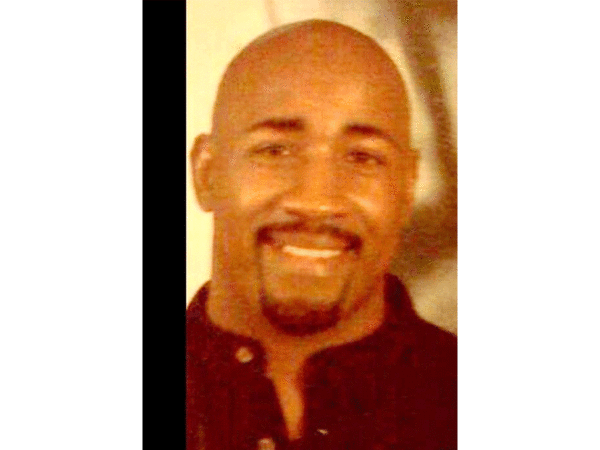
I know first-hand the effects of the disease for it fell my younger brother at the beginnings of life for a very handsome and intelligent young man. He was quite a trooper for he tried like hell to not let the disease block his professional desires. But sickle cell disease beat him down, but he fought a gallant war. He joined the armed services only to have a constant wet boot during basic training break the skin and a sore formed that never healed. For a time, he drove a school bus and if my memory serves me correctly, drove the agency van on occasion when sickle cell patients needed to be transported to doctor’s appointments. I sold him my Camaro that was passed down to me by a cousin. He stunned us all when within a few days he had the engine of the car on a set of chains and pullies lifted high on the branch of our tree in the yard. At less than 125 lbs., that guy rebuilt the engine using only borrowed tools and the engine specs. Freaked me out for the guy did not even know how to change the oil – or at least that is what I thought. Even though my mom cussed at the mess in the yard she could not help but take a ride in it when he finished. I sometimes wonder what he would be doing about now had he lived.
The effort to unlock the mysteries of sickle cell disease continues and a new breath of fresh air is abound. Scientists with the Broad Institute and St. Jude Children’s Hospital appear to have found paydirt. But just to think that a single transaction – the change of a component of a gene sequence in which a single letter of the genome spawns the conversion of another genome letter to another. “In sickle cell disease, a hemoglobin molecule mutation causes the hemoglobin molecules to stick together thus creating sickle-shaped red blood cells”. “This can lead to blood cell rupture, anemia, recurring pain, immunodeficiency, organ damage, and early death”. In the current research model, a method called gene base editing, researchers simply change a single letter of the genome. In sickle cell disease, the hemoglobin letter T is changed by the mutation to an A. Gene base editing in essence converts the T to a C at that same key location. The now “Makassar variant” produce red blood cells with significantly reduced sickling.
The insurmountable challenge facing scientists now is gathering a pool of patients ready to advance the research to become either a one-time treatment or what is hoped is a cure. Unfortunately, the timing may be a barrier – by June 7th, less than 9% of the African American population has received at least one dose of the COVID-19 vaccine. Recent efforts targeting places frequented – barber shops, beauty shops; paring gas cards and phone cards and cash cards to vaccine has experienced a level of participation to reverse the trend – a leap to 11% is viewed as a signal of the narrowing of the racial gap.
The truly bold and daring and adventurous and futurists among us, should google the June 2, 2021, issue of Nature. The more information you have the more solid the decision you make to chart the course for a new day in the annuls of health care of the underserved.