
Each year, some of our local high schools receive deceptive letter grades that hide poor performance of students. Politicians brag about success, and students stick their chests out, without realizing that there is a performance problem beneath the letter grade that must be addressed.
Nine out of ten Carroll High students missed grade-level Mastery this spring. Six out of seven at Richwood did too. At Wossman, four out of five. These are our children, sitting in classrooms a few miles from schools, telling a different story. At Sterlington, roughly six in ten students meet the state’s bar. At West Monroe, better than four in ten do. The gap between the two ends of this district is no longer a gap. It is a chasm, widened long enough.
This is not an indictment of teachers or families. Educators walking into Carroll, Richwood, and Wossman each morning work as hard as any in this parish. The problem is structural, and sympathy will not raise a Mastery score. A plan will.
Start by paying to compete for talent, the way successful businesses do. An alumni- and community-funded recruitment fund could offer real signing bonuses to draw proven teachers into our hardest classrooms, rather than hoping the status quo improves on its own.
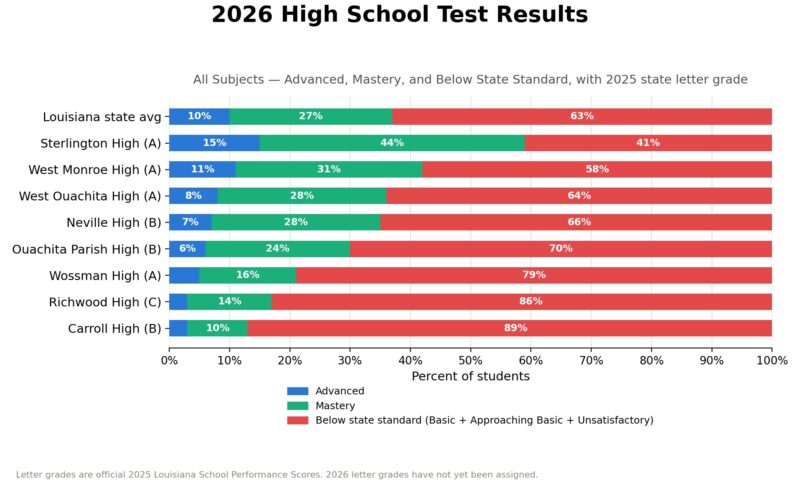
School letter grades, which measure more than just academics, often mask poor student performance in core subjects.
Stop the revolving door. Many struggling campuses have cycled through multiple principals and much of their faculty in just a few years. No strategy takes root in soil tilled annually. Retention bonuses, mentorship pipelines, and multi-year leadership commitments must become priorities, not afterthoughts.
Shrink the classroom. Smaller classes let a teacher catch a struggling student in October, not February. Shift spending on extra-curricular activities to strategies to improve academic performance
Raise the bar for extracurricular eligibility. A higher required ACT score to play, march, or perform tells every student the classroom comes first.
Build real bridges between home and school, leaning on this community’s churches and civic organizations rather than asking schools to carry every family alone.
Protect instructional time. Every calendar interruption costs more at a school already behind than at one that is thriving.
And rebuild the pride. Sterlington’s success is not only resources; it is a community that believes in its school and says so. That pride can be built elsewhere, too.
None of this is cheap or easy, and each idea deserves real debate over cost and consequence. But the alternative to hard choices is not neutrality — it is another year of the same results. The data is in front of us. The only question left is whether we have the will to act on it.